All
Behind the Investments
Why we invested in Enerin
Bringing high-temperature heat pumps to the long tail of industrial heat
A silent but massive decarbonisation lever
Global energy demand continues to rise. A substantial portion of this demand comes from industrial activity, and within that, heat is the largest single energy use. Industrial heat accounts for 25% of global energy consumption. Of this, medium-high temperature processes in the 100-200 degrees Celsius range represent approximately 5% of total global energy use.
This segment remains heavily dependent on fossil fuels, particularly natural gas. Electrifying this heat with high-temperature heat pumps is a credible decarbonisation path, especially in markets where electricity prices are competitive with gas.
There are a few high-temperature heat pumps operating in this range, but they have been built for large-scale, stable heat demands of 20 megawatts and up. They are developed for steady-state operations in large industrial complexes, where the heavy engineering and operations costs are somewhat manageable. Such systems are not suitable for the long tail of smaller industrial sites. These more common factories and facilities often require less total process heat (<20 MW), and/or require that heat to be distributed across more than one system, and/or operate with some level of fluctuating input and output temperatures. The list goes on, but in short: the existing technology does not fit.
Enerin is closing this gap with a novel technology that meets the needs of these users, enabling them to finally electrify most or all of their heating processes.
A product made for the real-world small industrial site
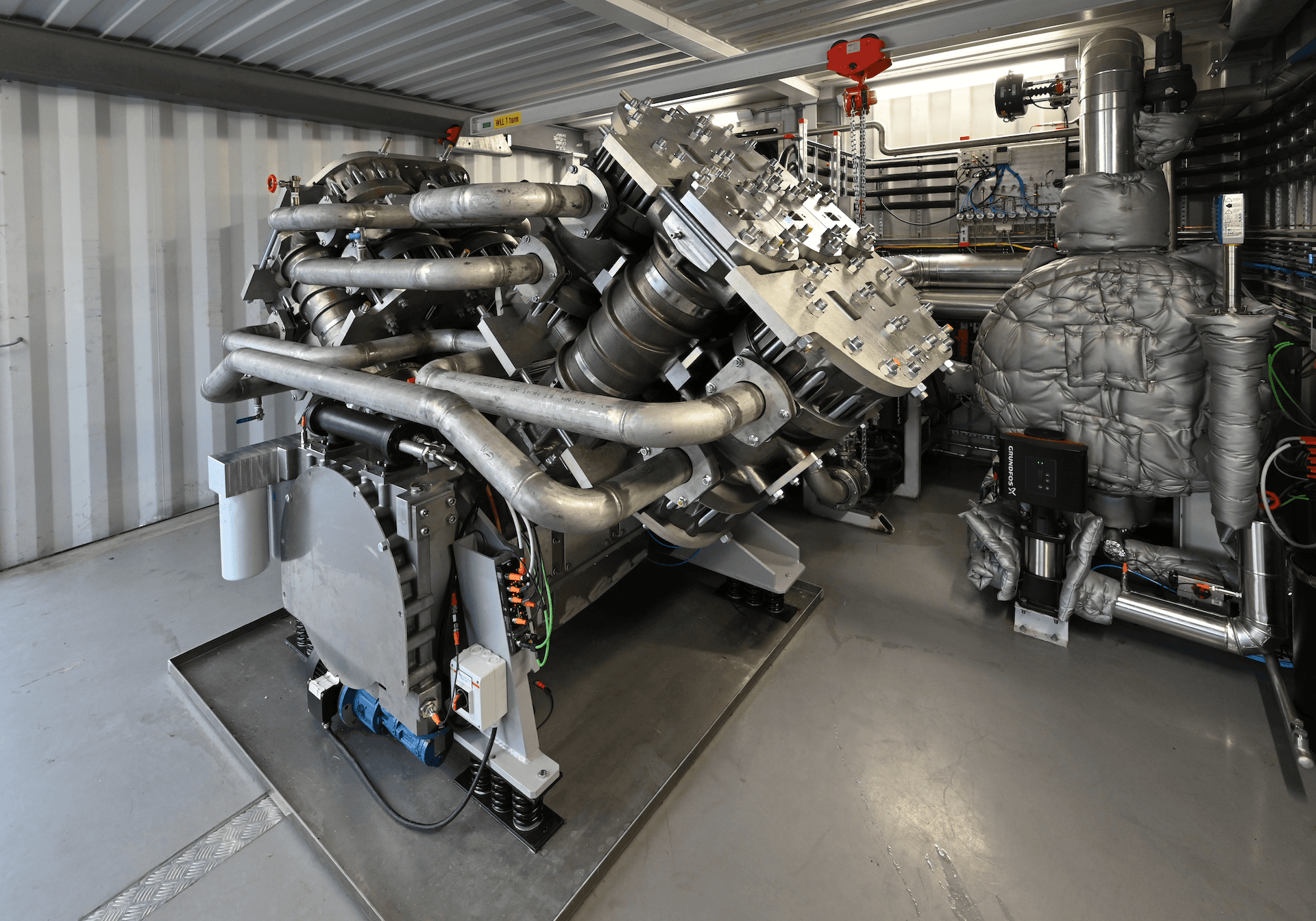
Enerin has developed a modular, high-temperature heat pump based on the Stirling cycle. Each unit delivers up to 1 MW of thermal energy, with a single-stage lift up to 200 degrees Celsius (a 2 MW system delivering up to 250 degrees Celsius is under development). This architecture matters. Competing systems typically require multiple compression stages to achieve similar temperatures, which increases cost, complexity and vulnerability to variations in operation. Multi-stage systems do not cope well with start-stop cycles, varying inlet conditions or fluctuating demand. These are precisely the conditions found in most industrial settings.
Enerin’s design avoids these limitations. The system is closed-loop and modular, meaning it can be installed in tight spaces such as boiler rooms. It is easy to maintain, requires minimal engineering per installation and uses only safe, non-toxic refrigerants (currently helium, with a transition to hydrogen in the next couple of years).
Enerin has ultimately managed to do this by resolving some of the main technical challenges of Stirling systems, particularly relating to seal durability, heat exchanger efficiency, and system design (reducing complexity). These improvements are protected by patents. While the Stirling cycle itself is not new, Enerin’s approach is distinct and their product is commercially ready.
In many cases, Enerin’s system is the only viable electric alternative for facilities that cannot accommodate large compressor arrays or that require rapid operational flexibility. It fills a critical gap between expensive large-scale heat pump systems and low-end electric boilers, neither of which are fit for purpose in this segment.
A market shaped by economic and regulatory pressure
Enerin’s first customers are found in sectors like food and beverage, pharmaceuticals, paper, biogas and chemicals. These industries rely on process heat but operate in smaller and more fragmented facilities. Typical heat requirements are below 10 megawatts per site and the companies are under pressure to decarbonise - but lack suitable technologies for their scale and site conditions.
Across Europe, there are more than 50,000 industrial sites that fall into this profile. In the Nordics alone, where electricity prices are relatively low and carbon prices are set and increasing, Enerin’s serviceable market is in the billions. Broader European markets are expected to follow as carbon taxes rise and electricity becomes cheaper due to increased renewables generation.
Future growth is expected to come from three directions. First, from deeper engagement with existing multi-site customers who can standardise on Enerin’s system. Second, from replication in standardised use cases such as biogas processing. Third, from new product variants that unlock higher efficiency or larger-scale installations, particularly a planned 2 MW hydrogen system.
Enerin’s technology also enables bundling with thermal storage, electrified cooling or even distributed power solutions. The underlying Stirling IP is adaptable beyond process heat, making this a platform with room to grow.
A business built on tangible value and repeatability
At this point Enerin sells its equipment directly to industrial customers or through energy companies (providing heat-as-a-service). At current prices, Enerin’s 1 MW system offers a highly attractive IRR (often over 30%) in low spark-spread markets. Subsidies in key regions, such as Norway, can cover 20 to 50 percent of capital expenditures, improving the business case further.
Service revenue will become more important as the installed base grows, but the design philosophy is deliberately simple. Few moving parts, inert fluids and long maintenance cycles reduce operational complexity for both the customer and Enerin.
Once installed, Enerin’s systems are likely to become the default solution across a customer’s facility network. This embedded repeatability is expected to emerge as one of the strongest drivers of long-term value.
A team grounded in experience and iteration
Enerin is led by a founding team with long-standing experience in Stirling-based heat systems and industrial energy. The team has worked in this space for nearly two decades. The current system is the third iteration, refined through lessons learned from earlier prototypes and pilot deployments.
Their advantage is not theoretical. They have already solved the problems that typically limit this kind of system in real-world use, including technical reliability, deployment constraints and cost of ownership. These are not engineers working in isolation, but practitioners who understand industrial operations and have spent years working with end-users to refine the product.
This is a team that knows the industrial landscape, understands the customer and has built a product that is already working under real conditions.
With the recent addition of Jacob Nørgaard Andersen as COO, bringing deep experience in scaling clean energy businesses. His background in building high-performing teams and managing large-scale energy projects adds exactly the capabilities required as Enerin transitions from technology leadership to serial production and broader market deployment.
For us, this addition reinforces the company’s readiness to execute on the next phase of its development.
Our view
Enerin is targeting a very large and high-impact segment of industrial energy use that has been systematically underserved. The product is differentiated, the market is ready, and the team has the technical and practical background to deliver. What remains is execution, particularly in scaling operations and building commercial depth. If they succeed, Enerin is well positioned to become the standard solution for electrifying small-scale industrial heat across Europe and beyond.
This is why we invested.